Math - Quiz Game
- 4.7
- Rating
- 1.00M
- Installs
- Free
- Price
 Analysis by App-foxy
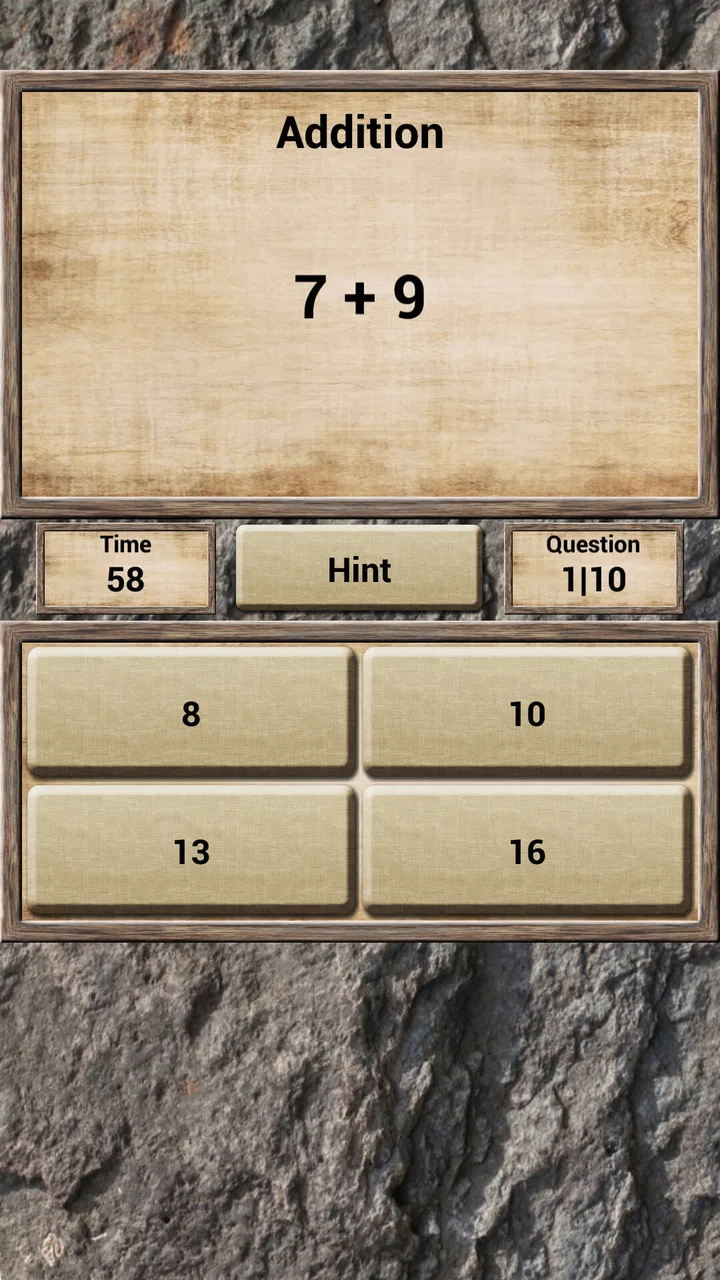
Math - Quiz Game is the kind of trivia game I open when I want something useful to do for a few spare minutes. It focuses on arithmetic rather than general knowledge, covering areas such as addition, subtraction, percentages, fractions, and other basic mathematical exercises. That sounds simple, but the format makes a difference: instead of reading explanations, I have to make a decision quickly and see whether my answer holds up.
That makes it a reasonable choice for mental practice, school-age learners, or adults who want to keep everyday calculations fresh. It is free to start, rated for Everyone, and comes from Atom Games Ent. The game has built a strong audience, with over one million installs and a 4.7 average from around seven thousand ratings. Those figures suggest that the straightforward approach works for many people, although they do not remove the need to decide whether this particular style suits you.
Getting past the first points of friction
My first advice is not to judge the game by the store summary alone. “Math quiz” can mean very different things depending on whether you want lessons, timed challenges, detailed explanations, or simple question practice. This title is best approached as a compact exercise tool. If you expect a full mathematics course, you may feel that it moves too quickly from question to question.
You May Also Like

 Blood Strike: 2.5 Anniversary
Blood Strike’s Loadouts Turn Every Drop Into a Tactical Gamble
A close look at Blood Strike’s custom loadouts: how fast access to signature weapons reshapes its battle royale rhythm, rewards preparation, and narrows the gap between fights.

 Pandora - Music & Podcasts
Pandora’s Music Is Easy to Start, but Harder to Recover
Pandora’s strength is its low-effort path from a seed to a station. Its weak spot is how much confidence it asks you to place in connection, setup, and quiet recovery.

 8 Ball Pool
 Is Built on Rivalries, Rematches, and Routine
A close look at the rivalries, rematches, shared routines, and unanswered safety questions that turn a quick pool match into a persistent mobile community.

 Samsung Music
’s Quiet Strength Is Playing What You Already Own
Its reach comes less from spectacle than from dependable access to a personal library. That simplicity is both the app’s strongest retention engine and its ceiling.

 AccuWeather: Weather Radar
AccuWeather Review: A Quick, Clear Forecast for Everyday Decisions
For everyday plans, the best forecast is the one you can understand quickly. AccuWeather makes rain timing, radar, and local conditions easy to act on, with a few trade-offs.

 Hill Climb Racing
Why Hill Climb Racing Still Turns Crashes Into One More Run
A tiny car, a bumpy hill and one more upgrade: Hill Climb Racing keeps resurfacing because its simple chaos makes every near-miss feel personal.
More From Our News Desk



The initial setup should be uncomplicated on a compatible device. The game runs on Android 5.0 or later, and the current version is 1.0.52. Before installing, I would check the operating system rather than assuming that any older phone will handle it. On a recent device, that check is usually routine; on an older handset, it can save time and avoid confusing installation problems that have nothing to do with the game itself.
Another useful check is storage space. A failed installation or interrupted update can look like an app fault when the real issue is a nearly full phone. I normally remove a little unnecessary material first, then retry the installation with a stable connection. If the download pauses, I avoid repeatedly tapping the install button. Closing the store, reopening it, and checking whether the game is already installed is a cleaner recovery path.
Because the game is free, there is no purchase decision required before trying it. However, in-app purchases range from $0.99 to $29.99 per item. I would keep that in mind if a child will use the device, especially when the phone or tablet is shared. The content rating is Everyone, which fits the educational arithmetic focus, but an age rating does not replace sensible purchase controls on a family device.
The most important setup choice is expectation, not configuration. Install it when you want repeated calculation practice, not when you need a teacher beside you explaining every mistake. That distinction prevents much of the disappointment people can experience with quiz-style learning apps.
What the question format is good at
The strongest part of this game is its low barrier to entry. Addition and subtraction are familiar enough to begin without preparation, while percentages and fractions make the practice more relevant to older learners and everyday tasks. I can imagine using it before shopping, while waiting for an appointment, or during a short break when opening a larger educational platform would feel excessive.
There is also value in switching between comfortable and uncomfortable areas instead of repeating only easy sums. If fractions slow you down, that is useful information. I would treat a wrong answer as a signal about what deserves another round, rather than rushing to protect a perfect-looking result. Short sessions make that approach manageable because the game does not require me to plan a full study period.
One practical workflow is to use the game as a warm-up before homework. I would spend a few minutes on basic calculations, notice which type of question causes hesitation, and then move to written work with that weakness in mind. This is more effective than playing passively for a long time, because the quiz becomes a quick diagnostic rather than background entertainment.
For adults, the benefit is slightly different. Percentages and fractions appear in discounts, bills, recipes, measurements, and budgeting. A quiz cannot replace checking an important financial calculation, but it can make mental arithmetic feel less rusty. I would use it to build speed and confidence, then verify anything consequential with a calculator or a second method.
Recovering when a session does not go smoothly
Quiz games are sensitive to small interruptions. If the app closes, freezes, or fails to respond, I would begin with the least disruptive steps: return to the game, reopen it, and check whether the phone itself is responding normally. If other apps are also sluggish, the problem is probably broader than this title. Restarting the device can clear a temporary system issue without changing anything inside the game.
When an update behaves strangely, I would confirm that the device still meets the minimum operating-system requirement and that the store is not waiting for another download to finish. A weak connection can make an update appear stuck, while low storage can prevent it from completing. These checks are more useful than immediately deleting the app, particularly if I have not considered whether progress or local settings might be affected.
If the game opens but a particular question seems wrong, I would first read the wording carefully and check the operation step by step. Fractions and percentages are easy to misread, especially when I answer quickly. I would also make sure that the issue is repeatable rather than a single rushed response. A clear note of the exact question and what happened is more helpful for troubleshooting than simply saying that the quiz is broken.
There is a trade-off here between speed and learning. The faster I try to answer, the more likely I am to make a careless mistake. The game encourages quick recognition, but I get more from it when I pause after an error and explain the calculation to myself. If I only restart immediately, I may preserve a score while missing the concept that caused the problem.
For a child, I would sit nearby during the first few sessions. Not because the content is unsuitable—the rating is Everyone—but because a young player may interpret a wrong answer as failure instead of feedback. Asking the child to show the calculation can reveal whether the difficulty is arithmetic, reading, or simply rushing. That small change turns a quiz into a more useful learning routine.
When the app is not the real problem
Some apparent difficulties come from the surrounding device or the way the game is being used. A dim screen, distracting notifications, or a cramped keyboard can make simple questions feel harder. I prefer a quiet setting and a short session, particularly for fractions and percentages. The goal is to test mathematical recall, not endurance against a cluttered phone.
Connectivity can also confuse the diagnosis. If installation or updating fails, I would test another connection and check whether other downloads work. If the game is already installed and the problem appears only during a session, I would look at general device performance first. Closing demanding background apps and restarting the phone are sensible general steps, while repeatedly reinstalling should be a later option.
There is another possibility: the game may simply be below or above the learner’s level. Someone who needs visual explanations, worked examples, or a carefully graduated curriculum may find the quiz format too thin. Conversely, someone already comfortable with advanced algebra will probably find arithmetic questions too basic. In both cases, the limitation is a mismatch of purpose rather than a technical defect.
This is where the usual alternatives become important. A calculator is better for checking one urgent answer. A textbook or structured learning platform is better for understanding why a method works. A classroom or tutor is better when mistakes keep repeating and the learner cannot identify the missing step. Math - Quiz Game is more convenient than those options for quick repetition, but it is not a replacement for them.
I also would not choose it as the only tool for exam preparation. Repeated questions can improve fluency, yet exams often require written reasoning, multi-step problem solving, and careful interpretation. The game can serve as a warm-up or revision break, but I would pair it with exercises that require showing work. That combination gives speed practice without confusing speed with complete understanding.
Small habits that make practice more useful
I get better results when I decide on a purpose before opening the game. One session might focus on accuracy, where I take time to check each operation. Another might focus on mental speed, where I answer naturally and review the mistakes afterward. Mixing those goals without noticing can make the results difficult to interpret.
A second useful habit is to keep a mental list of recurring trouble spots. If percentages repeatedly cause errors, I would stop treating each mistake as an isolated event. I would review the relationship between the percentage and the whole amount away from the quiz, then return later. The game is valuable as a detector of weak areas, but the actual repair may need a notebook, an example, or a conversation with a teacher.
For families, I would avoid turning every session into a competition. A child who is still building confidence may benefit more from explaining one correct answer than from chasing a faster result. Adults can use the same approach: accuracy first, speed later. This is a small change, but it reduces the temptation to guess and makes the practice more transferable to real calculations.
Purchase awareness is another practical point. Since the game is free but includes optional items, I would review the device’s purchase settings before handing it to a child. I would not assume that a free download means every part of the experience is free. Trying the basic game first is the sensible approach, and any later spending should be a deliberate decision rather than the result of an accidental tap.
Who should install it, and who should skip it
I would recommend this game to learners who want accessible arithmetic practice without setting aside a long study block. It is especially suitable for someone revisiting addition, subtraction, percentages, and fractions in short bursts. Parents may also find it useful as a supplementary activity, provided they help interpret mistakes and do not expect the app to provide complete instruction.
It can work well for adults who want a more active alternative to scrolling. A few questions while waiting for a bus or during a coffee break can be more engaging than a passive puzzle, and the arithmetic focus has a clear everyday connection. The free entry point makes it easy to test whether the question style feels comfortable before committing to regular use.
I would skip it if your main need is detailed teaching. If you need diagrams, step-by-step solutions, adaptive lessons, or advanced mathematics, a dedicated learning service is likely a better fit. I would also skip it as a primary tool for serious exam study. Its value is in practice and recall, not in replacing a complete curriculum.
Device owners should also be realistic about compatibility. Android 5.0 is the minimum requirement, so anyone using an older system will need a newer device or another option. If installation fails on a compatible phone, I would investigate storage, connection, and store behavior before blaming the game. That distinction matters because the solution may be simple, but only if the cause is identified correctly.
My practical verdict after using the quiz format
Math - Quiz Game succeeds because it keeps the central action clear: read a mathematical question, work it out, and answer. Atom Games Ent. has chosen a format that is easy to understand and easy to fit into a busy day. The coverage of basic operations, percentages, and fractions gives it more practical value than a game limited to one kind of sum.
My reservation is that simplicity can become a limitation. A quiz can show where I hesitate, but it may not fully explain how to improve. I would therefore use it as one part of a routine: short practice in the game, written examples for difficult topics, and a calculator when accuracy has real consequences. That workflow gives the app a clear job instead of asking it to do everything.
The title was released on November 16, 2017, and its continued availability in version 1.0.52 makes it an established option rather than a brand-new experiment. Its free price and Everyone rating lower the risk of trying it, while the optional purchases mean families should still pay attention to device controls. The audience size and 4.7 average are encouraging, but my recommendation rests more on the focused design than on popularity alone.
In everyday use, I would keep it for quick arithmetic refreshers, homework warm-ups, and identifying topics that need more attention. I would not rely on it for explanations, advanced mathematics, or formal preparation by itself. If you want a lightweight mathematics quiz that turns spare minutes into active practice, it is worth trying; if you need a full teaching system, choose a more structured alternative.
That is the fairest way to view it. It is not a substitute for a teacher, textbook, or calculator, but it does not need to be. Used within its proper role, Math - Quiz Game offers a convenient way to exercise basic calculation skills and make weak spots visible without making the routine feel like a lesson.
FAQs for Math - Quiz Game
01What age group is Math - Quiz Game suitable for?
Math - Quiz Game is designed for a wide range of users, typically suitable for ages 6 and up. It caters to both children and adults by offering varying difficulty levels. Younger users can enjoy basic arithmetic challenges, while older players can tackle more complex problems, making it an educational tool for all.
02Does Math - Quiz Game require an internet connection?
Math - Quiz Game can be played offline, making it convenient for users without constant internet access. However, some features, such as leaderboards and updates, may require an internet connection to function fully. This allows you to enjoy the core game anywhere, anytime.
03Are there in-app purchases in Math - Quiz Game?
Yes, Math - Quiz Game offers in-app purchases. While the core features are free, users can purchase additional content such as new levels, hints, or ad-free experiences. These purchases are optional and primarily enhance the gameplay experience without affecting the educational value.
04How does Math - Quiz Game keep players engaged?
Math - Quiz Game keeps players engaged through a combination of diverse quizzes, increasing difficulty levels, and interactive challenges. It also includes achievements and leaderboards to motivate users to improve their scores and compete with friends, adding a social and competitive element to the learning process.
05Is Math - Quiz Game available on both Android and iOS?
Yes, Math - Quiz Game is available on both Android and iOS platforms. This ensures that users can enjoy the game regardless of their device preference. The app is optimized for both systems, providing a seamless experience with consistent updates and support for each platform.
Pros
- Engaging quizzes for all ages.
- Adaptive difficulty levels.
- User-friendly interface.
- Offline play available.
- Regular content updates.
Cons
- Limited free content.
- Occasional ads interruptions.
- In-app purchases required.
- No multiplayer mode.
- Requires frequent updates.

Math - Quiz Game
Gallery